Articles
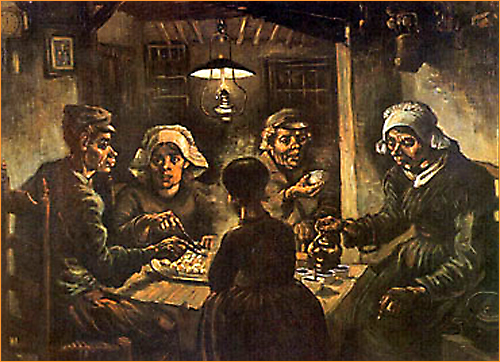
De aardappeleters, 1885. Vincent van Gogh
The Dutch kitchen has been particularly inspired by agricultures and livestock-farming past of the Netherlands. Although the kitchen by region can differ from specific products, there is a number of typical Dutch Food Courts and ingredients.
Dutch food are frequently firm and nutritive, coordinated on the mainly physical activities which the Dutchman did in the past.
The Dutch kitchen is open for influences from outside. To the colonial past dutch food with Indian or Surinamese origin borrowed
and from the French, Italian, Greek, German and Spanish kitchen Courts and/or ingredients have been also taken over.
www.fooddutch.com
Northeastern Dutch Food
The regions in the north and east of the Netherlands, roughly the provinces of Groningen, Friesland, Drenthe, Overijssel and Gelderland north of the great rivers make up north eastern Dutch food.
The region is the least populated area of the Netherlands; and, historically, the least developed part. The late (18th century) introduction of large scale agriculture means that the cuisine is generally known for its many kinds of meats. The relative lack of farms allowed for an abundance of game and husbandry, though dishes near the coastal regions of Friesland, Groningen and the parts of Overijssel bordering the IJselmeer also include a large amount of fish.
The various dried sausages, belonging to the metworst-family of Dutch sausages, are found throughout the region and are highly prized for their, often very strong, taste. Most towns and various villages have their own variety of this sausage. The region also produces the traditional smoked sausages, of which (Gelderse) rookworst is the most renowned. These sausages traditionally have been smoked over wood chips, and are served after they' ve been boiled in hot water. The sausage contains a lot of fat and is very juicy. Larger sausages are often eaten alongside stampot, hutspot or zuurkool; whereas smaller ones are often eaten as a street food.
The provinces are also home to many kind of pastries and cookies. In contrast to southern Dutch cuisine, which tend to be soft and moist, the northeastern pastries generally are of a hard texture and heavily spiced with ginger or contain small bits of meat. Various kinds of Kruitkoek (such as Groninger koek), Fryske dúmkes and small savoury pancakes (including spekdikken) can be considered typical.
In terms of alcoholic beverages the region is renowned for its many bitters (such as Beerenburg) and other high-proof liquor rather than beer, which (apart from Jenever) is typical for the rest of the country.
Western Dutch food
The provinces of North Holland, South Holland, Zeeland, Utrecht and the Gelderlandic region of Betuwe are the parts of the Netherlands which make up the region in which western Dutch cuisine is found. The area is known for its many dairy products, which includes prominent cheeses such as Gouda, Leyden (spiced cheese with caramin, cumin or cloves), Edam (traditionally in small spheres) as well as Leerdammer and Beemster, while the adjacent Zaanstreek in North Holland is known for its mayonaise and mustards.
Zeeland and South Holland produce a lot of butter, which contains a larger amount of milkfat than most other European butter varieties. A by-product of the butter-making process, buttermilk, is also considered typical for this region.
Sea food such as Herring (eaten raw) mussels, eels, oysters and shrimps are widely available and typical for the region. Kibbeling, once a local delicacy consisting of small chunks of battered white fish, has become a national fast food.
Pastries in this area tend to be quite doughy, and often contain large amounts of sugar; either caramelised, powdered or crystalised. The oliebol (in its modern form) and Zeeuwse bolus are good examples. Cookies are also produced in great number and tend to contain a lot of butter as well as a filling of some kind, mostly almond.
The traditional alcoholic beverages of this region are beer (strong pale lager) and Jenever, a high proof juniper-flavored spirit. A noted exception within the traditional Dutch alcoholic landscape, Advocaat, a rich and creamy liqueur made from eggs, sugar and brandy, is also native to this region.
Southern Dutch food
Southern Dutch cuisine constitutes the cuisine of the Dutch provinces of North-Brabant and Limburg and the Flemish Region inBelgium. It is renowned for its many rich pasteries, soupes, stews and vegetable dishes and is often called Burgundian which is a Dutch idiom invoking the rich Burgundian court which ruled the Low Countries in the Middle Ages renowned for its splendor and great feasts.
It is the only Dutch culinary region which developed a haute cuisine and it forms the base of most traditional Dutch restaurants including typical main courses served such as Biefstuk, Varkenshaas, Ossenhaas, these are premium cuts of meat, generally pork or beef, accompagnied by a wide variety of sauses and potatoes which have been double fried in the traditional Dutch (or Belgian) manner.
Stews, such as Waterzooi or Hachee, a stew of onions, beef and a thick gravy, contain a lot of flavour and require hours to prepare. Vegetable soups are made from richly flavored stock or bouillon and typically contain small meatballs alongside a wide variety of different vegetables. Asparagus and witlo(o)f are highly prized and traditionally eaten with cheese and/or ham.
Pastries are abundant, often which rich fillings of cream, custard or fruits. Cakes, such as the Vlaai from Limburg and the Moorkop andBossche Bol from Brabant, are typical pastries. Savoury pastries also occur, with the worstenbroodje (a roll with a sausage of ground beef) being the most popular.
The traditional alcoholic beverage of the region is beer. There are many local brands, ranging from Trappist to Kriek. Beer, like wine in French cuisine, is also used in cooking; often in stews.
Dutch Liquorice
A famous Dutch sweet is zoute drop, salty liquorice and liquorice sweets. These sweets are small, black and look much like gums. The four types of drop are soft sweet, soft salt, hard sweet and hard salt drop. Drop can be bought in shops and pharmacies and has a medical function as it helps to cure throat and stomach aches.[9] Dutch drop is sold in a large variety of shapes and forms. Dropcan be either sweet or salty (or very salty). It is sometimes flavoured with coconut fondant (Engelse drop or English drop ), honey (honingdrop ), mint (muntdrop ), salmiak (salmiakdrop), or laurel (laurierdrop). Typical shapes are diamonds, ovals, oblongs and coins. Honeycomb shape for honeydrop are also familiar. Some manufacturers have introduced speciality ranges where the drop is made in thematic shapes, such as cars (autodrop), farm animals and farm machines, rys (boerderijdrop), etc.
Dutch Pancakes
A pannekoek (pronounced: pah-nuh-cook) (plural pannekoeken) or pannenkoek (new Dutch spelling) is a Dutch pancake.[1] Pannekoeken are usually larger and thinner than American or Scottish pancakes. They may incorporate slices of smoked bacon, apples or other fruits, stem ginger, cheese, or raisins. Plain ones are often eaten with stroop and powdered sugar. The ingredients are flour, milk, and eggs. Beer may also be added to the mixture in order to give it a better flavour, but most of all it helps the batter rise. In Dutch pancake restaurants many more toppings can be ordered with them, including eggs, pear, or even pineapple, and they are often topped with Dutch stroop (sugar beet syrup), a dark, thick syrup common in the Netherlands. The closest taste equivalent to this syrup in the U.S. is sorghum syrup.In the Netherlands, a pannenkoek naturel in a pannenkoekenhuis is a plain pancake which one can top with as much powdered sugar or stroop as one desires from the condiments standing on the table.